Raw in, training-ready outRobot and human data, before and after training
Euler reads raw robot and human data, from first-person video and teleoperation to deployed robot logs, simulation, flight logs and image sets, and returns it layered, measured and ready to train on. This is what each layer produces, what it is for, and how well it holds up.
Physical AI does not run short of recordings. It runs short of recordings a trainer can use. A raw file says what a camera saw and what a robot logged. A training set needs to know which hand acted, on which object, in which step, where the camera was, what the robot was told to do, and whether any of it can be trusted.
That gap exists on both sides of a training run. Before training, human video, teleoperation, simulation and image sets have to become labeled, synchronized episodes. After training, deployed robots produce logs that record what a policy actually did, and that record has to become evaluation and the next round of data. Euler does both with one pipeline and one review surface.
Every input, one pipeline
Each recording is inspected and routed to the right reader, so a team rarely has to name a format. The data kind is then derived from what the episode actually contains, and it decides which layers and which checks exist at all. A first-person clip has no gripper to check, a flight log has no hands to pose, and a loose image has no timeline.
That one rule is what lets the same platform serve data before training and data after it.
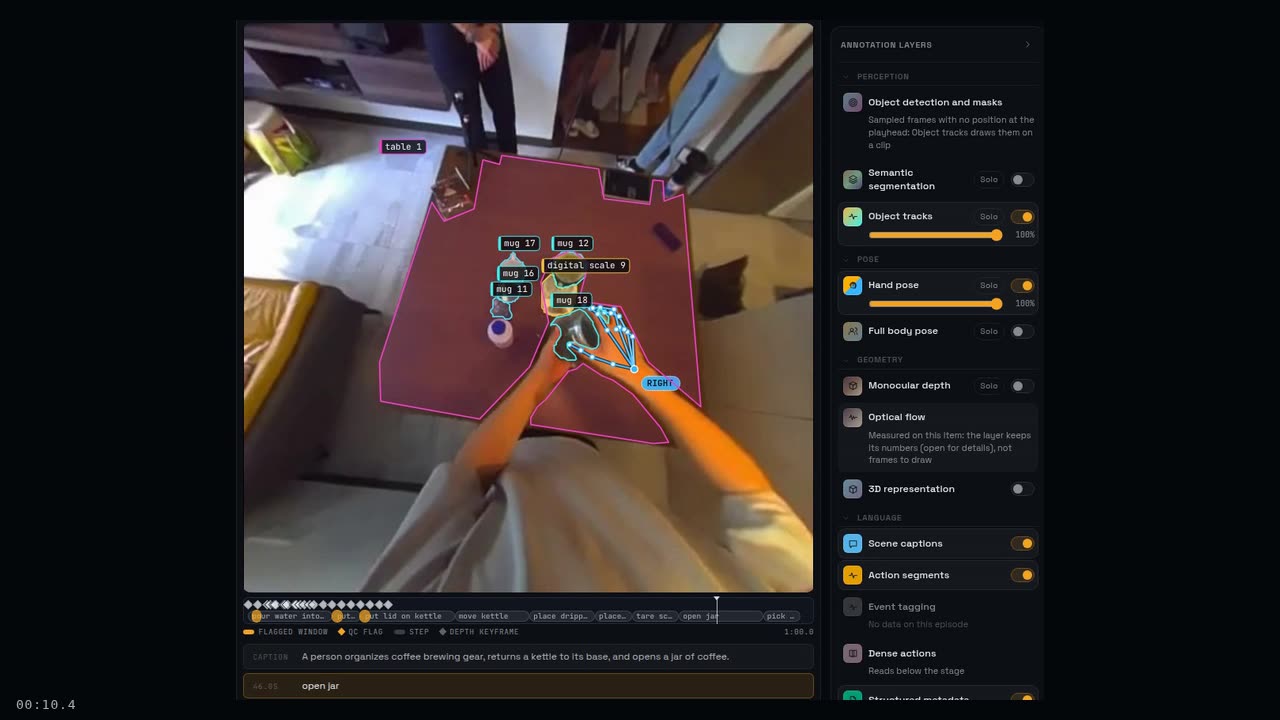 Before trainingFirst-person human videoReads head and chest cameras, with the camera's own motion telemetry when it was recordedYields steps, actions, the wearer's hands in 2D and 3D, objects, depth, a camera pathFig. 1
- Before trainingTeleoperationReads arm demonstrations with commanded actions, joint state and gripperYields synced streams, smoothness and gripper checks, steps and actions
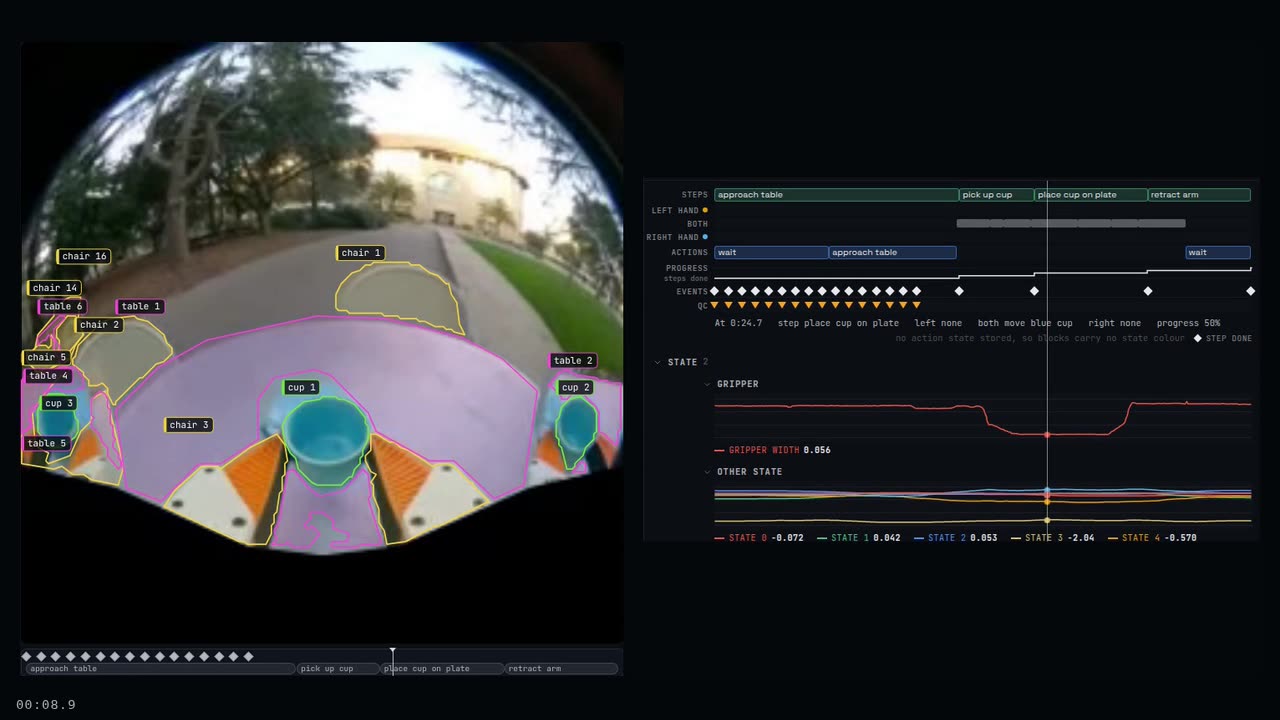 Before trainingHandheld gripperReads a gripper carried by hand, with its camera and its own trajectoryYields gripper streams on the video's clock, outlines, a camera pathFig. 11
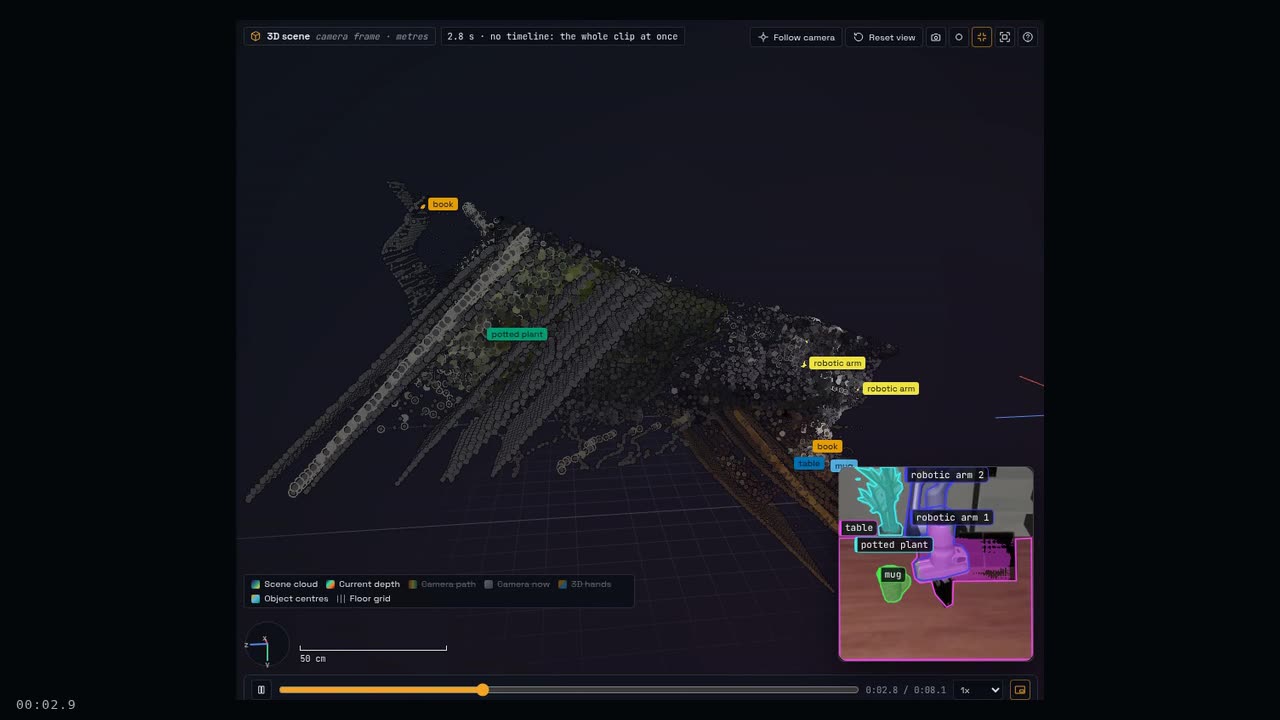 Before trainingSimulationReads rendered episodes with exact stateYields the same layers and checks as real data, point clouds from depthFig. 12
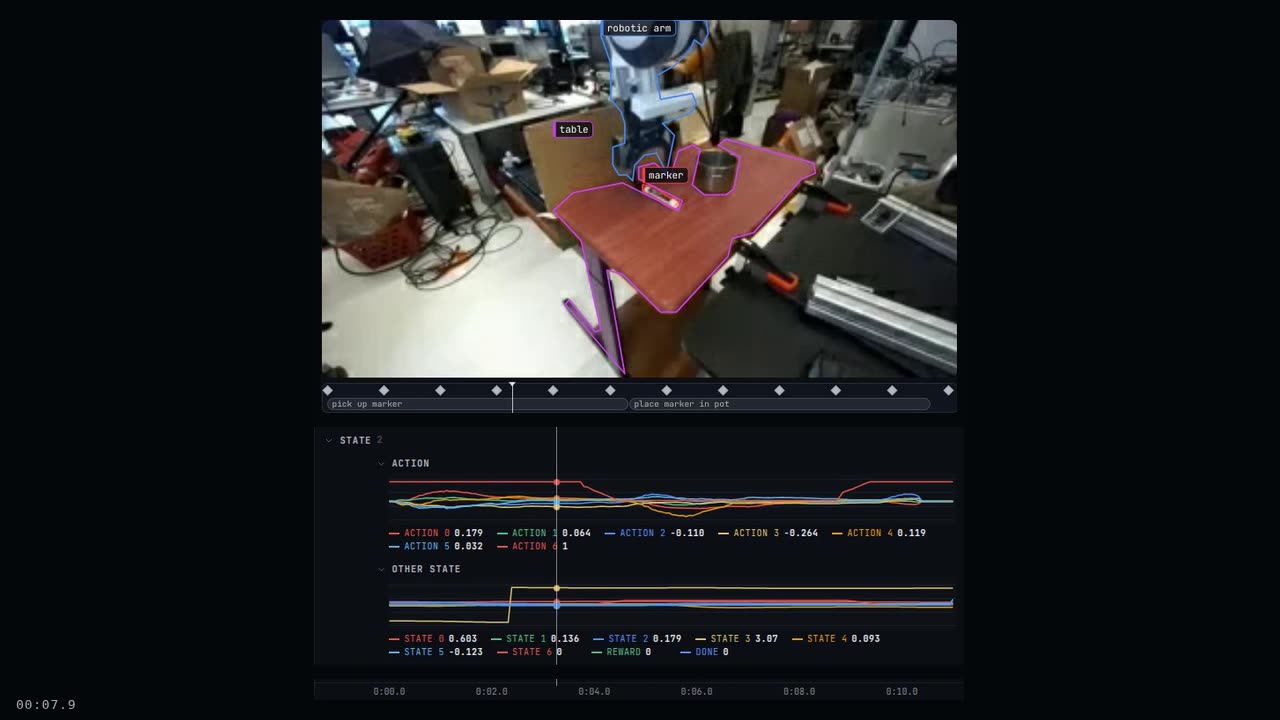 After trainingDeployed robot logsReads a robot arm's episodes with its control and state streamsYields episodes scored for readiness, findings placed in time, evaluation setsFig. 2
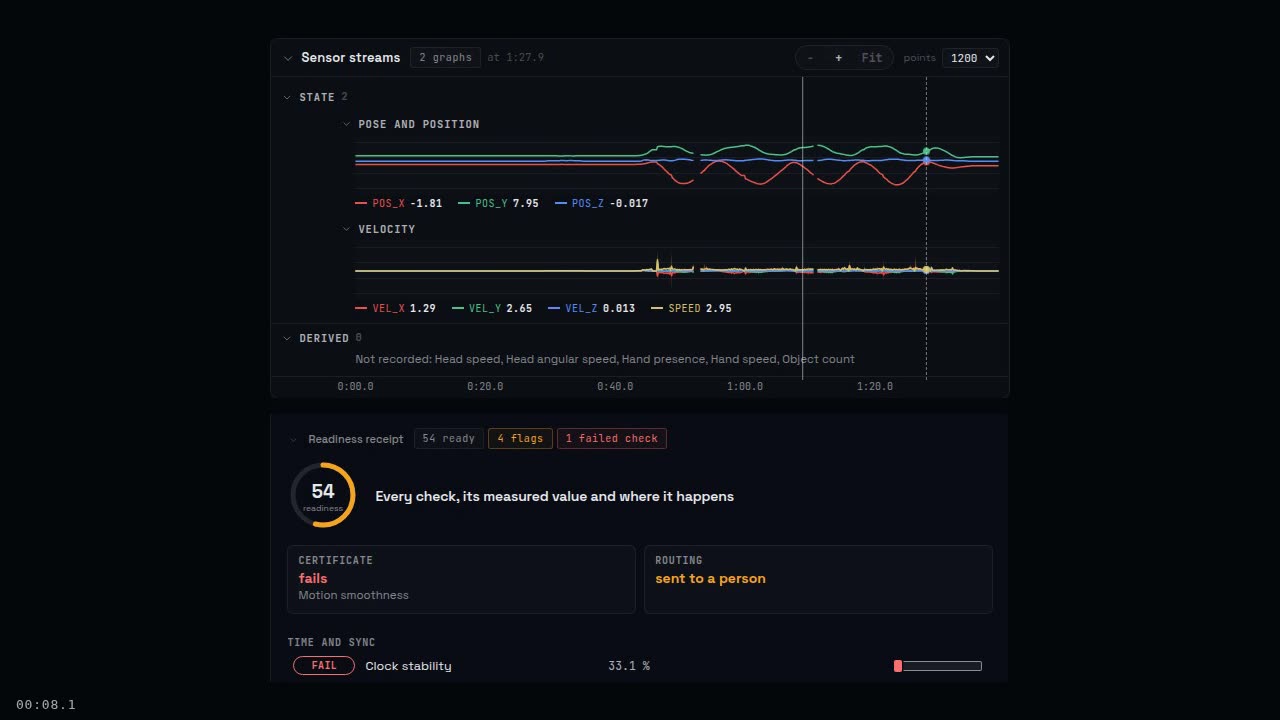 Before and afterAerial flight logsReads pose and velocity streams, with video when it was recordedYields plotted state on one timeline, timing and coverage checksFig. 3
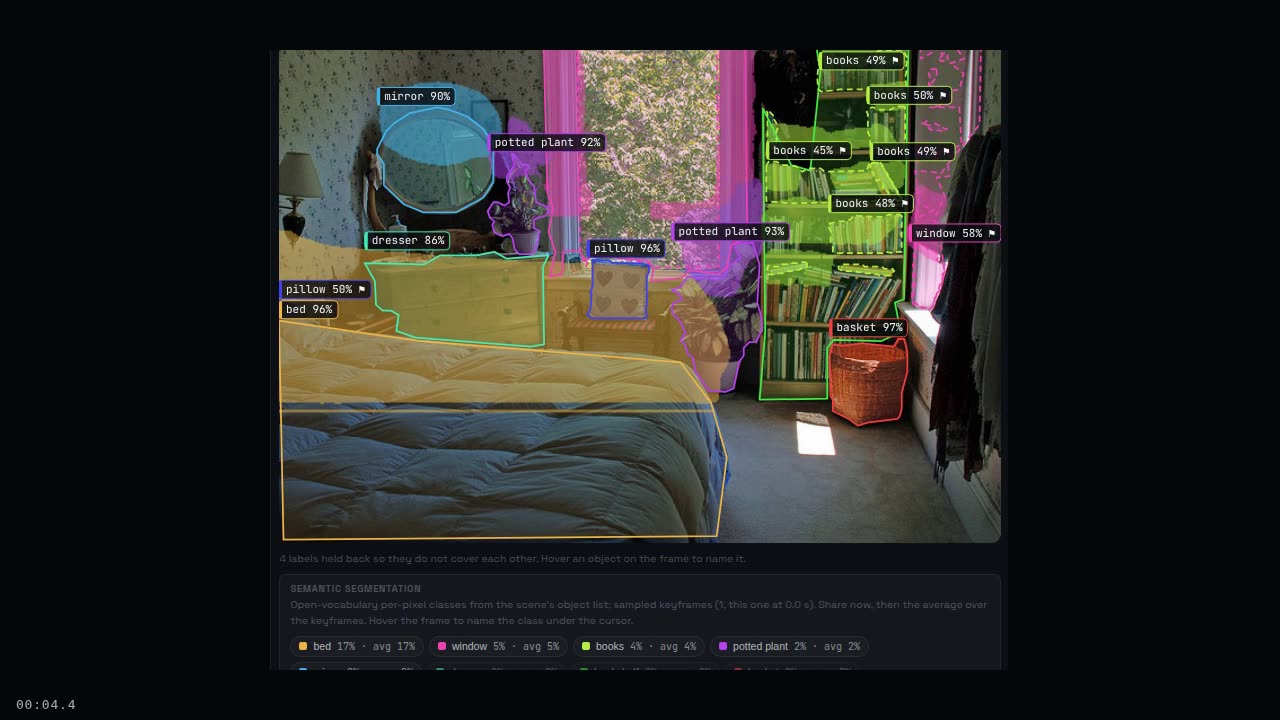 Before trainingImage datasetsReads loose images, with a caption file when one existsYields outlines and masks against your vocabulary, image-quality checksFig. 6
- Before and afterRobot log containersReads the containers robot teams already log to, with video and tables insideYields episodes with decoded streams and a timing summary for each one
A check that a class of data cannot satisfy is removed before scoring, not scored as zero.
Every stream on one clock
A policy learns from observations paired with actions. If the camera and the arm disagree on when something happened, the model learns to act on what it has not seen yet. So the first thing Euler does with any recording is put every stream on the video's clock: commanded actions, joint state, gripper, inertial telemetry, pose and velocity.
The review surface plots those streams under the picture with one playhead, next to the signals the layers derive, such as hand speed or head motion. A click on a graph seeks the video. A stream the recording does not carry is labeled as not recorded rather than drawn as a flat line, because a zero is a measurement and an absence is not.
Head cameras often carry more than pixels: an accelerometer, a gyroscope, a gravity vector and a per-frame orientation. Aligned to the video, that is the inertial half of a camera path, already on the memory card. Flight logs are the same idea with different streams. Position, attitude and velocity arrive as tables, and Euler decodes them into named, grouped graphs on the same timeline.
Language at the grain of an action
Language comes in three layers: a caption per clip, named steps per segment, and dense actions at the level of single moments. The grain matters. A policy cannot learn picking up a sponge from a span that also contains rinsing it and putting it back.
On delivered first-person data, dense actions have a median length of 2.5 s and cover 100% of each episode's time.1 Full coverage is the point: a gap in the action timeline is a stretch of video a trainer can only use by guessing. Every action sits inside its step and names the hand that performed it.
Policy learning from human video needs labels at the grain of a grasp, not a chore.
Objects, outlines and masks
Objects are found against the team's own vocabulary and stored as outlines from instance masks, not as boxes alone. Those outlines are what perception models and pretraining runs consume, and what a reviewer checks a label against.
A head camera never stops moving, which is hard on tracking. On head-mounted footage, the overlap between one frame's mask and the next has a median of only 0.41 to 0.55, so a mask carried forward slides off its object within seconds. Euler's tracks are built for that motion and carry an outline on every tracked frame. Figure 5 shows a fast head turn: most identities hold, and the caption says where they do not.
The same layer runs on loose images. A vision dataset gets outlines against its vocabulary, low-confidence detections routed to review, and image checks for exposure, sharpness and contrast measured against the rest of the set.
Hands, in two dimensions and in three
Human video teaches manipulation through the hands. Euler stores 21 keypoints per hand, left and right, with handedness decided once per track so a hand never swaps sides mid-clip. On first-person data a filter keeps only the camera wearer's hands, so a person standing beside the wearer never becomes training signal.
On a recording with hand motion capture, a refinement pass raised the share of frames with both hands present from 67.8% to 79.8%, and the pixel error on matched frames did not move.2 Presence is not accuracy, which is why we report both.
3D hands
3D hands are now a shipped option, chosen per project on the 3D layer. They sit in the same metric, gravity-aligned frame as the camera path and the point cloud, so a hand trajectory reads in meters against the scene it acts on. That is the form retargeting and 3D policy learning need.
Their accuracy is tied to depth. Given exact depth, the lift recovers a synthetic hand to under 5 mm;5 on real frames, the depth scale along the viewing ray sets the error. The review surface marks hands far from a depth keyframe as lower trust, and an export can leave the layer out.
Geometry for world models
World models learn how a scene changes as the camera moves through it. That needs the motion of the camera and the shape of the scene, in units. Euler produces metric depth per keyframe with the camera's intrinsics, a camera path over the whole episode in a gravity-aligned frame, and point clouds built from both.
The depth view carries its own instruments: a metric color bar with a range lock, the depth under the pointer in meters, a two-point measure and a wipe between picture and depth. When a record is relative rather than metric, it says so.
We measure geometry against ground truth, not by eye. Depth has the right shape: fitting a single scale per frame takes its error from 0.209 to 0.076. The camera path holds metric scale to within 1.4% with no scale fit. On wide indoor lenses the raw depth reads about a fifth long, so scale, not structure, is the quantity we watch.
| Area | Measurement | Result |
|---|---|---|
| Depth | Absolute relative error, raw metric3 | 0.209 |
| Depth | Absolute relative error, one scale per frame | 0.076 |
| Depth | Pixels within 25% of truth, raw / one scale per frame | 68.8% / 93.7% |
| Camera path | Trajectory error over a 60 s window, no scale fit4 | 0.168 m |
| Camera path | Metric scale against the device's head pose | within 1.4% |
| Camera path | Rotation error, median | 0.11° |
| 3D hands | Joint error of the lift on a synthetic hand with exact depth5 | under 5 mm |
Point clouds claim no accuracy of their own. They inherit the depth and the camera path, so those are what we measure.
Robot data, before and after training
Robot data arrives in containers: MCAP and ROS bags, HDF5 recordings, parquet tables beside video, existing LeRobot datasets. Euler decodes them into episodes with every topic's timing summarized, so a dropped camera or a stalled joint stream is visible before anyone trains on it.
After training, the same reader takes in what deployed robots record. A rollout log carries the policy's commands and the robot's state beside its cameras. Scored for readiness and reviewed on the same surface, those logs become evaluation sets and the next round of fine-tuning data, with each finding placed at the moment it happened. The perception layers run on robot video too, so a rollout can be found by what was on the table and what the arm did with it.
Before training, some of the most plentiful robot data comes from people holding a gripper and from simulation. A handheld gripper records its camera and its own trajectory; a simulator records exact state. Both run through the same layers and checks as data from a real robot, so a mix of sources lands in one consistent format.
Readiness you can check
Readiness is Euler's judgment of whether a recording is fit to train on. It is a blend of deterministic checks, each with a plain name, a reason it matters for training, and the data kinds it can never apply to. Sixteen general checks cover every kind:
- Timeline and clock stability
- Control smoothness and dead time
- Sensor alignment
- Gripper signal
- Instruction match
- Camera coverage and image quality
- Label readiness and annotation coverage
First-person data adds checks on how it was captured and on what Euler produced from it, each measured in physical units such as a rate in hertz, a gap in seconds or a coverage share:
- Hands in shot
- Camera on the head
- Clear lens
- Exposure stability
- Head motion
- Frame integrity
- Uninvolved objects
- Near-duplicate clips
- Telemetry sync
- Step and action coverage
- Hand and track coverage
- Depth and camera-path coverage
We list what is checked, not how it is scored. Every check that can place its finding in time does, so the review surface can show the moment and the frames.
The more important choice was what gets certified. A certificate that reads only the raw input will say first-person video is not ready for a vision-language-action model, because language, a task timeline and aligned telemetry are missing. They are missing because producing them is the pipeline's job. Euler certifies the delivered output, and re-measures it from stored files without running any model again.
We audit our own flags too. On one batch, every flag was checked against the frames it pointed at, and each traced to a defect in the measurement, not in the data: a clock offset, a countertop counted as an untouched object, dark clothing read as clipped exposure.6 Those were fixed in the checks. Two rules hold throughout: a flag routes an episode to human review and never rejects it on its own, and a re-measure never overwrites a human decision.
Certify what you deliver, not only what came in.
A frame is a frame
A reviewer judges a label by looking at it on the picture. If a skeleton trails its hand by one frame, a correct label looks wrong. So we measured the player. The test clip carries its frame number as a burned-in barcode, the overlay draws the number of the frame it was drawn for, and the composited screen is read back frame by frame.7
At first, picture and pose came from the same frame on only 17% of screen frames. The clock was exact; the lag was presentation, because an overlay drawn by the page reaches the screen a compositor frame or two after the video. The obvious fix, drawing on a canvas in the video frame callback, measured 26%. Painting the picture and the pose in the same task reached 99.5%, with the rest one frame apart.
Every layer, at a glance
Thirteen layers and the recorded streams, each with what it produces, what it trains and how it holds up. A layer runs only where the data can carry it, and the settings screen says why when it cannot.
- LanguageScene captions
- Produces
- One clear sentence per clip, with object hints.
- Trains
- Instruction grounding for vision-language-action models; search.
- Holds up
- Checked for agreement with the frames it describes.
- LanguageAction segments
- Produces
- Named steps, a verb and a noun per span.
- Trains
- Task structure for long-horizon and hierarchical policies.
- Holds up
- Steps must cover the active timeline and run forwards.
- LanguageDense actions
- Produces
- Every action inside each step, with the acting hand.
- Trains
- Action labels for policy learning from human video.
- Holds up
- Median 2.5 s per action, with every second of the episode covered.
- LanguageEvent tagging
- Produces
- Timestamped events in your schema, with evidence.
- Trains
- Evaluation and failure finding on third-person video.
- Holds up
- Each event carries the frames behind it and a reviewer's editor.
- LanguageStructured metadata
- Produces
- Scene, environment, lighting, camera motion, task category.
- Trains
- Balanced training mixes, curation filters and search facets.
- Holds up
- Values stay inside the fields you define unless you allow new ones.
- PerceptionObject outlines and masks
- Produces
- Named polygons from instance masks, against your vocabulary.
- Trains
- Detectors, segmenters and perception pretraining.
- Holds up
- Low-confidence detections route to review, never straight to export.
- PerceptionObject tracks
- Produces
- Each object followed through the clip, outlined on every tracked frame.
- Trains
- Object-centric world models and interaction learning.
- Holds up
- Identities hold through most head turns; Fig. 5 shows where they do not.
- PerceptionSemantic segmentation
- Produces
- Per-pixel class masks over your ontology.
- Trains
- Scene understanding and encoder pretraining.
- Holds up
- Boundaries are checked against depth; class coverage is reported.
- PoseHand pose
- Produces
- Twenty-one keypoints per hand, left and right, never swapped.
- Trains
- Policy learning and retargeting from human video.
- Holds up
- Handedness is decided once per track; first-person data keeps only the wearer's hands.
- PoseFull body pose
- Produces
- Whole-body keypoints for every person in frame.
- Trains
- Humanoid and whole-body learning from third-person video.
- Holds up
- Offered where a body is in view; off for head cameras, where it is not.
- GeometryMonocular depth
- Produces
- Depth in meters per keyframe, with estimated camera intrinsics.
- Trains
- World models and 3D-aware policies.
- Holds up
- Error 0.076 once one scale per frame is fitted; scale is the weak point on wide lenses.
- GeometryOptical flow
- Produces
- Dense motion between frames.
- Trains
- Motion cues for video models; it also exposes blur and dropped frames.
- Holds up
- Forward-backward consistency is the built-in check.
- Geometry3D scene and 3D hands
- Produces
- Camera path, point clouds, object centers and hands in one metric frame.
- Trains
- World models from ego-motion; 3D hand targets for retargeting.
- Holds up
- Camera path within 1.4% of metric scale; clouds inherit depth and path error.
- StreamsSensor and state streams
- Produces
- Telemetry, joint state, actions, pose and velocity on the video's clock.
- Trains
- Behavior cloning, dynamics, and the action half of every policy dataset.
- Holds up
- A stream that was not recorded is labeled absent, never drawn as zero.
- EvidenceReadiness and certificate
- Produces
- Measured checks per episode and a verdict for the project.
- Trains
- Evaluation, data selection, and the case for what goes into a run.
- Holds up
- Re-measured from stored files; a flag routes to review, never to rejection.
What this adds up to
One recording can serve several kinds of model, if its layers are there and can be trusted. Human video becomes policy data through its hands, steps and actions. Ego-motion and depth become world-model data. Outlines and masks become perception and pretraining data. Readiness becomes the evidence for evaluation and for deciding what goes into the next run.
Every export carries that evidence with it: a README written from the export's own files that states each file's schema, units, coordinate frame and time base, a readiness receipt per episode, and the project's certificate. Location and face streams never leave in an export.
Euler gets the most value out of data before and after training, for physical AI, multimodal and world models, and vision.
An earlier post described how a readiness certificate is built. This one covers the layers that certificate is about, across every input we read, and the measurements behind them.
Method notes
- 1Counted on delivered first-person data after the language layers were re-run. Coverage is the share of each episode's duration that falls inside a dense-action span. ↩
- 2A recording with hand motion capture. Presence is counted per frame; pixel error is measured only on frames where both the prediction and the capture exist. ↩
- 3Frames sampled across a recording with dense metric depth ground truth and a confidence map, scored after 2x2 area averaging. One scale per frame is the median ratio of truth to prediction. "Within 25%" is the usual δ1 measure. ↩
- 4Absolute trajectory error against the recording device's own head pose, with rigid alignment only and no scale fit. ↩
- 5A synthetic hand with exact depth, lifted with the same code that runs on real frames. On real frames the error is set by the depth scale along the viewing ray. ↩
- 6Every flag on one audited batch was checked against the frames it pointed at, one quality component at a time. ↩
- 7Production build in headless Chromium. The test clip carries its frame number as a burned-in barcode, the overlay draws the number of the frame it was drawn for, and the composited screen frames are read back and the two numbers compared. ↩
Any input on this page. Get the layers and the evidence behind each one.